Posted on

Embracing What is:  A Journey Towards Healing

By Liron Fuchs

Years ago, as a new expat, my life seemed picture-perfect. Professionally and socially, I was thriving. Yet, beneath the surface, something felt terribly wrong. I couldn’t explain it, but my body knew. Panic attacks gripped me while driving on highways. Merging onto four-lane roads, I’d lose feeling in my legs, my palms would sweat, and my heart would race uncontrollably.

As a yoga professional, I used every breathing technique I knew. My therapist guided me through coping strategies. But the anxiety always returned, eventually forcing me to stop driving altogether. Few years later, I discovered the truth: my husband’s boss, a trusted friend, had been deceiving and exploiting him while he worked for him. We had invited a master manipulator into our lives, blind to the calculated intentions beneath his facade. My body had sensed the danger long before my mind could interpret the red flags.

This experience taught me a profound lesson about the wisdom of our bodies and the messages hidden within our emotions. Allow me to share this journey with you:

Imagine waking up, anxiety wrapping itself tightly around your chest, suffocating the space within and squeezing all the air out of your lungs. “Here it is again,” you mutter. “Will this cycle ever end?”

In life’s grand tapestry, teachers appear in many forms. But sometimes, the most profound lessons unfold in the quiet whispers of our own hearts.

As the weight of anxiety feels overwhelming, you might fight against its grip, trying to push it away. But what if I offered you a different perspective? What if this persistent feeling serves a greater purpose?

Take a deep breath, Dear one. Embrace the tightness enveloping your chest. Feel the intensity, the ache pulsating through your body. Now, for the first time, let your anxiety speak.

“Dear Anxiety,” you might say, “what message do you yearn for me to understand? Why do you come to me with such force?”

To your surprise, it answers:

“I’m here to remind you that you’re alive. There’s a life inside you longing to be lived more fully. I hold so tightly because I’m a constant reminder of the meaningful work you must do for your freedom. The more you nurture your inner light, the more I shall release my grasp. My presence is a sign of love, urging you to remember your heart’s desires.”

As you listen, the grip loosens. The anxiety begins to fade, leaving behind a profound realization: even anxiety has meaning in your journey, leading you towards love and urging you to stay true to your soul.

When tension and pain grip us, our first impulse is to resist. Rarely do we pause to unravel the deeper truths they carry. Yet, nothing in our journey is meant to be feared or cast aside. Through acceptance and exploration, we find solace and peace.

Can we soften into the embrace of our emotions, welcoming them with love and curiosity? Can we dare to ask what truths they yearn for us to uncover?

Breathe yourself open, dear one. Let anxiety melt away, making space for life to flow freely through you. Befriend the spaces within that feel hard and closed, Let them soften, allow them to speak. See their presence as the messengers of love they truly are.


If this journey of self-realization resonates with you, I invite you to join me for a transformative 6-week Yoga for Trauma Recovery Program. Together, we’ll delve deeper into these concepts, using Yoga and journaling to contain our emotions, Re-trust our intuition, release tension, and find inner calmness. Healing is a choice, are you ready to make it?
Posted on

Yoga, Ancient Wisdom, and Modern Science

By Liron Fuchs

Ever wonder how the ancient practice of yoga aligns with modern science? Join me on a journey through fascinating connections between yoga, spiritual traditions, and cutting-edge neuroscience.

Ancient Wisdom Meets Modern Science

Yoga has been my passion and profession for years, but my journey of understanding its depths never ceases.
In one of my favorite books, “Anatomy of the Spirit” by Caroline Myss, Myss draws fascinating parallels between three spiritual traditions:
The seven Chakras, The Christian Sacraments and the The Kabbalah’s Tree of Life

Myss argues that these systems all describe a journey from basic physical needs to higher spiritual awareness, showing how different traditions have recognized similar patterns in human spiritual development.

Another fascinating read is Rose Erin Vaughan’s “The Science of Self”, exploring the parallels between Chinese Medicine and traditional Yoga. The way she describes the flow of Qi through meridians alongside the concept of prana moving through Nadis and Chakras resonates deeply with my own practice and teaching. She shows how these ancient traditions are both powerful attempts to explain the same thing: the human experience.

The Polyvagal Theory: A Scientific Lens on Yoga

What excites me most is how the traditional Yoga system aligns with contemporary neuroscientific models. When I first learned about Stephen W. Porges’s Polyvagal Theory in neuroscience, initially conceptualized in 1994 and still emerging, I felt it offers a voice to the ancient wisdom embedded in Yoga Practice we’ve known for thousands of years. 

Yoga: A Neurophysiological Path to Healing

All yoga is potentially therapeutic and healing. At the root of yoga’s power to heal is its education of a flexible nervous system. The Vagus nerve plays a key role in our autonomic nervous system, sending signals between your body and brain. It is the longest nerve in the body, extending from the brain stem into the stomach, intestines, heart, lungs, throat and facial muscles (the term Vagus is Latin for “Wandering”).

Key points about the Vagus nerve:

• Improved vagal tone helps balance the nervous system.
• Approximately 85% of vagus nerve fibers are afferent, meaning 85% of the information is coming from the body to the brain. This is an important point because that means that both of our mental and physical health is embodied.
• Learning how to regulate the vagus nerve can improve your response to emotional and physiological symptoms of depression, anxiety and PTSD, or potentially. inflammation-related diseases such as Inflammatory Bowel Syndrome or rheumatoid arthritis.

Understanding Your Nervous System Through Yoga

The three main ways your nervous system acts according to the polyvagal theory, and the Yoga equivalent:

1. The parasympathetic Nervous system/The Ventral Vagal Complex (VVC):

• Inner calmness state
• Normal heart rate, normal muscle tone
• Engaged, curious, creative, connected, relaxed and at ease

In The YogaSutra, Patanjali calls it ‘Sattva’: full of light as in radiance. We have clarity, awareness, we feel light as a feather and balanced

2. The Sympathetic Nervous System:

• Revved up, stressed out
• This is our “fight or flight” response
• Heart rate goes up, blood pressure goes up, muscle tone and hormones become affected

In Patanjali’s Yoga sutras we call it Rajas of the mind.  There’s energy, change, passion, and it’s dynamic. There could be agitation, excitement, movement

3. The Dorsal Vagal Complex (DVC):

• This is our ‘freeze’ response, activated in times of extreme stress
• Can’t think, can’t move, can’t talk
• The muscular system goes into freeze
• Our heart rate goes down, muscle tone goes down, energy goes down

It’s akin to the tamasic state in yoga – a state of shutdown or disconnection, characterized by heaviness, inactivity, lethargy, and inertia.

Interestingly, the freeze response, which we once attributed solely to the sympathetic nervous system, is actually controlled by the vagus nerve – This explains why yoga is so effective. By engaging the vagus nerve, yoga practices help us shift from a sympathetic (stress) state to a parasympathetic (rest and digest) state. This transition is crucial for healing, relaxation, and reducing anxiety and stress levels in our body.

Breathe Your Way to Balance: A Practical Exercise

To help you create greater health and balance within your autonomic nervous system, try the following simple breathing exercise:

This practice involves creating an even length of your inhalations and exhalations. Notice your body sensations, your breath and any emotions that are present for you as a baseline to notice subtle changes in how you feel through the practice:

1. Sit comfortably and close your eyes. Notice your breath and its quality. Can you soften its intensity?
2. Notice the length of your breath and explore a count of 4 on each inhalation, feeling your belly expand.
3. Exhale slowly for 4 counts, feeling your belly contract.
4. Repeat for 5-10 cycles.
5. If you become comfortable, experiment with a 6 count with an easy pause at the top, and a 6 count exhale. See if likewise, you can pause and rest at the edge of exhalation. Repeat for 5 more cycles.
6. What are you aware of now, as you notice your body, mind, emotions and energy? Take some time to observe, knowing you can come back to this practice as often as you would like.

Did this exploration of yoga and neuroscience spark your curiosity?
If you’re ready to experience these concepts in practice, please feel free to check out any of my yoga offerings. I’ll meet you where you are and we can explore more of these concepts together.

Practice with me

Posted on

Why we have so much to learn about sustainability from indigenous artisans

By Liron Fuchs

“In the Western tradition there is a recognized hierarchy of beings, with, of course, the human being on top—the pinnacle of evolution, the darling of Creation—and the plants at the bottom. But in Native ways of knowing, human people are often referred to as “the younger brothers of Creation.” We say that humans have the least experience with how to live and thus the most to learn—we must look to our teachers among the other species for guidance. Their wisdom is apparent in the way that they live. They teach us by example. They’ve been on the earth far longer than we have been, and have had time to figure things out.”
– Robin Wall Kimmerer, Braiding Sweetgrass: Indigenous Wisdom, Scientific Knowledge and the Teachings of Plants

This humble perspective, seeing ourselves as students rather than masters of nature, is woven deeply into the practices of indigenous artisans. As a yoga teacher, I’ve long explored practices that foster deep connections – to ourselves, to others, and to the earth. But it was during my travels to northern Argentina that I discovered profound teachers in sustainability and mindfulness: the Wichí native community and their art craft passed along through generations.

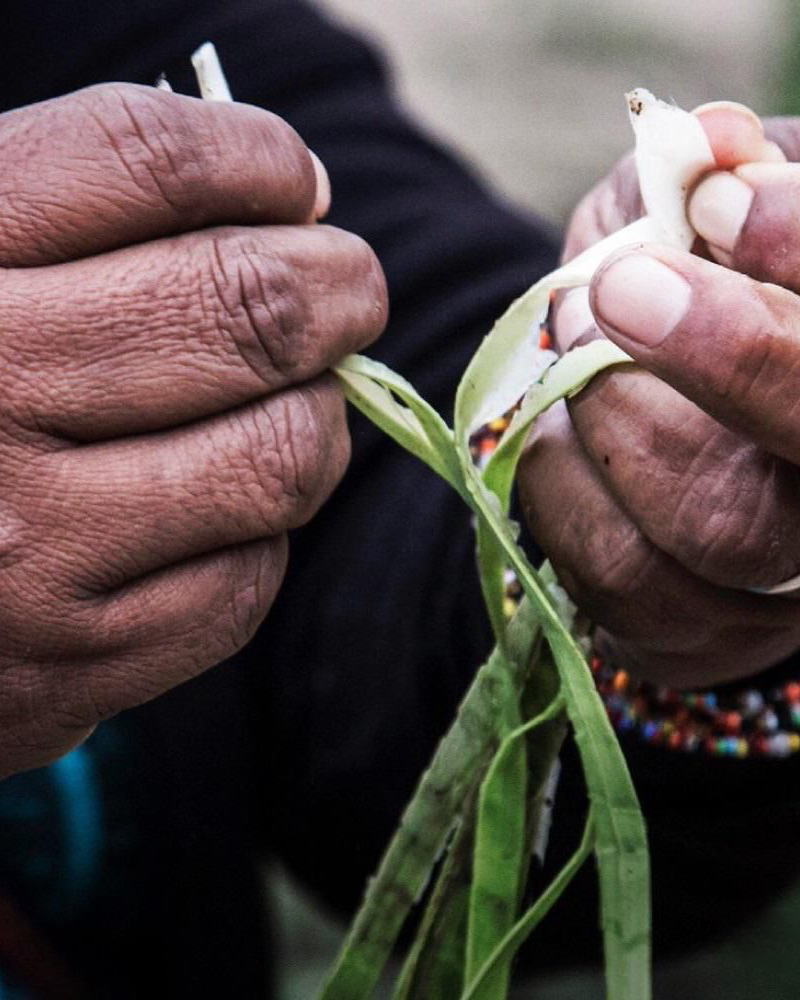
From the Wichi women to the skilled artisans in Colombia, Peru, and Bolivia, these communities offer living examples of sustainable practices and deep respect for Mother Earth. The Wichi’s craft with the Chaguar plant is a prime example. Their month-long process of creating a single piece – from careful harvesting, processing, dyeing to patient weaving – is a meditation on sustainability and mindful creation.
In the hands of these artisans, local materials become a testament to patience and reverence for nature. Whether it’s the Wichi’s Chaguar, Peruvian alpaca wool, or Colombian palm fibers, each resource is treated with respect, used fully, and transformed with care.

The weaving, pottery, and craft-making in these communities are more than artistic expressions – they are a dialogue with the earth, a practice of reciprocity. In our rush towards progress, we’ve forgotten that time is not always linear. The indigenous view of time is often cyclical, like the seasons, like the great migrations of birds and butterflies. This wisdom is reflected in their art – in the circular patterns and rhythmic weaves of their crafts.

As we face the mounting challenges of climate change and environmental damage, we would do well to sit at the feet of these elder brothers and sisters of craft. Their arts are not outdated practices from the past, but living seeds of a sustainable future. They show us how to walk softly on the earth, our feet bare to feel the pulse of the living land beneath us.

This is why this platform seeks to bring practices of yoga and indigenous art together. We believe that by bridging ancient wisdom with modern wellness practices, we create a holistic approach to health – one that nourishes not just our bodies and minds, but the planet too.

Let us approach with humility, ready to learn. Let us open our eyes to see the world as a gift, not a resource. For in the end, sustainability is not a technique to be mastered, but a relationship to be nurtured. It is a way of living that honors the reciprocity between all beings.

May we too become good ancestors, leaving a legacy of beauty, balance, and respect for all our relations.
I’ll end with another quote from the same book, since I love it so much:

“We need acts of restoration, not only for polluted waters and degraded lands, but also for our relationship to the world. We need to restore honor to the way we live, so that when we walk through the world we don’t have to avert our eyes with shame, so that we can hold our heads up high and receive the respectful acknowledgment of the rest of the earth’s beings.”
– Robin Wall Kimmerer, Braiding Sweetgrass: Indigenous Wisdom, Scientific Knowledge and the Teachings of Plants

Explore