

By Liron Fuchs
“In the Western tradition there is a recognized hierarchy of beings, with, of course, the human being on top—the pinnacle of evolution, the darling of Creation—and the plants at the bottom. But in Native ways of knowing, human people are often referred to as “the younger brothers of Creation.” We say that humans have the least experience with how to live and thus the most to learn—we must look to our teachers among the other species for guidance. Their wisdom is apparent in the way that they live. They teach us by example. They’ve been on the earth far longer than we have been, and have had time to figure things out.”
– Robin Wall Kimmerer, Braiding Sweetgrass: Indigenous Wisdom, Scientific Knowledge and the Teachings of Plants
This humble perspective, seeing ourselves as students rather than masters of nature, is woven deeply into the practices of indigenous artisans. As a yoga teacher, I’ve long explored practices that foster deep connections – to ourselves, to others, and to the earth. But it was during my travels to northern Argentina that I discovered profound teachers in sustainability and mindfulness: the Wichí native community and their art craft passed along through generations.
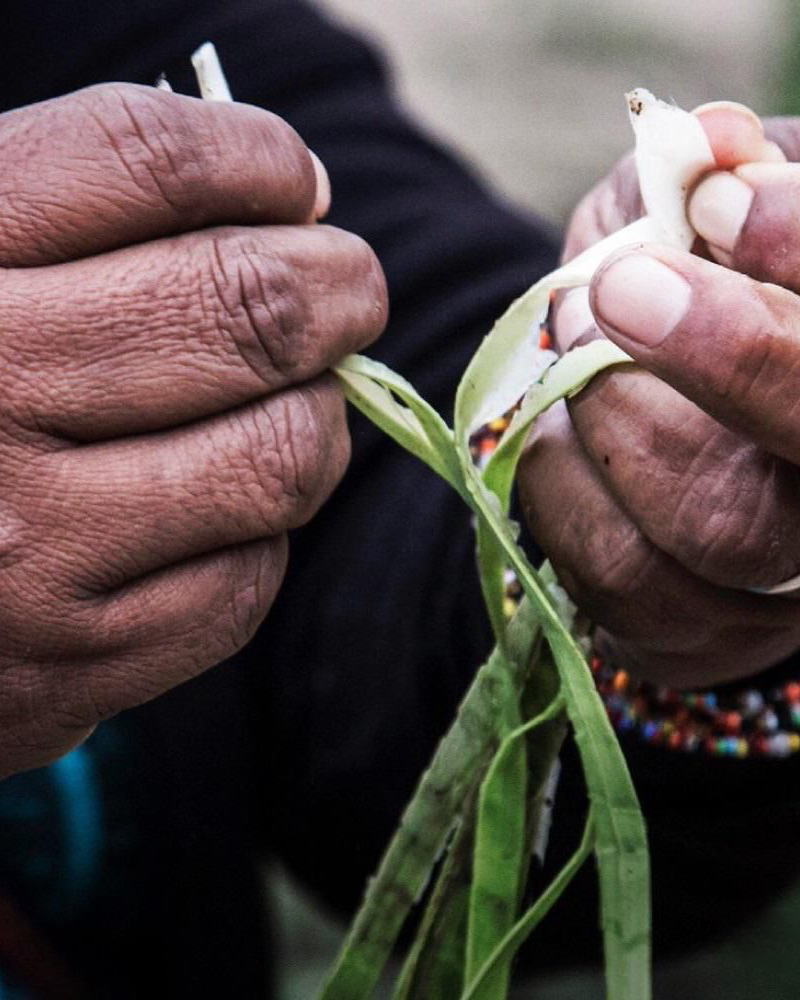
From the Wichi women to the skilled artisans in Colombia, Peru, and Bolivia, these communities offer living examples of sustainable practices and deep respect for Mother Earth. The Wichi’s craft with the Chaguar plant is a prime example. Their month-long process of creating a single piece – from careful harvesting, processing, dyeing to patient weaving – is a meditation on sustainability and mindful creation.
In the hands of these artisans, local materials become a testament to patience and reverence for nature. Whether it’s the Wichi’s Chaguar, Peruvian alpaca wool, or Colombian palm fibers, each resource is treated with respect, used fully, and transformed with care.
The weaving, pottery, and craft-making in these communities are more than artistic expressions – they are a dialogue with the earth, a practice of reciprocity. In our rush towards progress, we’ve forgotten that time is not always linear. The indigenous view of time is often cyclical, like the seasons, like the great migrations of birds and butterflies. This wisdom is reflected in their art – in the circular patterns and rhythmic weaves of their crafts.
As we face the mounting challenges of climate change and environmental damage, we would do well to sit at the feet of these elder brothers and sisters of craft. Their arts are not outdated practices from the past, but living seeds of a sustainable future. They show us how to walk softly on the earth, our feet bare to feel the pulse of the living land beneath us.
This is why this platform seeks to bring practices of yoga and indigenous art together. We believe that by bridging ancient wisdom with modern wellness practices, we create a holistic approach to health – one that nourishes not just our bodies and minds, but the planet too.
Let us approach with humility, ready to learn. Let us open our eyes to see the world as a gift, not a resource. For in the end, sustainability is not a technique to be mastered, but a relationship to be nurtured. It is a way of living that honors the reciprocity between all beings.
May we too become good ancestors, leaving a legacy of beauty, balance, and respect for all our relations.
I’ll end with another quote from the same book, since I love it so much:
“We need acts of restoration, not only for polluted waters and degraded lands, but also for our relationship to the world. We need to restore honor to the way we live, so that when we walk through the world we don’t have to avert our eyes with shame, so that we can hold our heads up high and receive the respectful acknowledgment of the rest of the earth’s beings.”
– Robin Wall Kimmerer, Braiding Sweetgrass: Indigenous Wisdom, Scientific Knowledge and the Teachings of Plants